
The short version: Most motorbike security advice assumes you own a driveway, a garden, or at least a side passage. If you live in a flat with nothing but the street, that advice doesn’t fully apply to you. This guide covers what actually works when on-street parking is not a temporary inconvenience but your permanent, every-night reality, including storage alternatives, the right security setup, insurance, and two legal points most riders never think to check.
Most of the security advice on this site, and most security advice anywhere, is written around having some kind of private outdoor space. A driveway you can bolt a ground anchor into. A side passage with a wall to fix an anchor to. Even a rear garden gives you a fixed point and some concealment.
If you live in a flat or a rented property with no private outdoor space at all, none of that applies. Your bike lives on the public road, every night, indefinitely. That is a genuinely different problem from the one most security guides are solving, and it deserves its own answer rather than a workaround bolted onto driveway advice.
This is not a temporary away-from-home situation either. If you’re touring or stopping over somewhere for one night, our guide to security away from home covers that. This page is for the permanent, day-in-day-out reality of having nowhere else to put the bike.
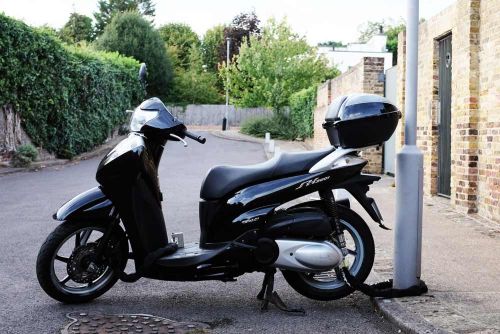
Why permanent street parking is a different problem
There is no fixed point, ever. A driveway owner can install a ground anchor once and be done. On a public street, you have no legal right to fix anything to the pavement, a lamp post, or a railing, even if it would make your bike considerably safer. Every security layer you use has to be self-contained.
The same spot, every night, indefinitely. Unlike an overnight touring stop, a thief casing a street has as long as they like to study your bike, your routine, and your security. Familiarity works against you here in a way it doesn’t for a one-off stop.
You are dependent on other people’s parking decisions. Permit zones, resident bays, and general street parking pressure mean you may not always get the same spot, or any spot near your front door. That affects how consistent your security setup can realistically be.
Weather exposure is constant and long-term. A driveway bike at least benefits from being on your own property where you can check on it daily. A bike on the street, especially some distance from your door, gets less day-to-day attention.
None of this means street parking is unmanageable. It means the approach has to be built around the absence of a fixed point rather than pretending one exists.
Your storage options, realistically
Before getting into locks, it’s worth knowing what alternatives to plain street parking actually exist, because most riders in this situation don’t realise they have more than one option.
On-street parking (the default). For most flat dwellers this is the only realistic option day to day, and it can be made considerably safer with the right approach to spot selection and layered security, covered below.
Council-provided motorcycle parking bays. A number of UK local authorities install dedicated motorcycle bays, and some include a ground anchor or a fixed rail specifically for locking to. These are free or low-cost in most areas and are significantly more secure than an ordinary parking spot, but they’re not universal and not always well publicised. It’s worth checking your local council’s website or calling their parking services team directly, since this information often isn’t easy to find through a general search.
Private secure storage or lock-up rental. In cities and larger towns, motorcycle-specific secure storage facilities and rentable lock-ups exist, often at a modest monthly cost. These typically offer a genuine fixed anchor point, a roof, and sometimes CCTV, and can be a good option if your bike is high value or if street parking near your flat is genuinely poor. Search for “motorcycle storage” plus your city or “secure motorbike lock-up rental” to see what’s local to you.
Communal bike or motorbike stores. Some larger blocks of flats and newer developments include a communal cycle or motorbike store. If yours does, use it even if it feels underused or slightly awkward to access, it is almost always safer than the street, and often has a fixed point to anchor to.
If none of these are realistic for you, on-street parking with the right setup is still a manageable situation. The rest of this guide covers exactly that.
Choosing your spot on the street
Where you park matters more when you have no anchor point, because positioning becomes one of your only defences.
Under a working streetlight. Sounds obvious, but it’s worth checking the light actually works at night rather than assuming it does.
Within view of a window, ideally your own. A bike you can see from your flat gets checked on far more often than one round the corner. If your own window doesn’t overlook a suitable spot, a neighbour’s frequently-used window is the next best thing.
Somewhere with regular foot or vehicle traffic. A quiet dead-end street with no passing footfall gives a thief far more time and privacy to work than a busier road.
Away from blind spots and gaps between parked cars a van could reverse into. Lift-and-load theft needs space to bring a vehicle alongside. A bike boxed in tightly between two parked cars is harder to load than one at the end of a row with clear access.
Consistency has a downside. Parking in exactly the same spot every night makes your routine predictable. Where you have any choice at all, vary it slightly.
The security setup that actually works with no anchor point
Without a fixed point to chain to, your security has to rely on immobility through weight and awkwardness, noise, and making the bike a worse target than the one down the street. This is a genuinely different combination from a driveway setup, and it’s worth being specific about what to buy rather than assuming a home setup translates directly.
A D-lock through the wheel and, ideally, the frame. This is the core of a no-anchor setup. A D-lock doesn’t just lock the bike to itself, used through the rear wheel and swingarm or frame it prevents the wheel turning and adds a rigid barrier that takes real effort and the right tools to defeat. See our guide to the best motorcycle D-locks for Sold Secure rated options. Many manufacturers such as Litelok offer a range of lock sizes so you are more likely to find one that can fit through swing arms and wheels.
A second, independent lock. Two different lock types mean two different tools and techniques are needed to beat them both, which meaningfully increases the time and noise involved. A chain and D-lock combination, or a D-lock through the front wheel and another through the back, is considerably harder to defeat than either alone. See our guide to the best motorcycle chains and locks.
An alarmed disc lock as standard. On a residential street, an alarm going off at 2am is genuinely disruptive and noticeable, even more so than in a quiet driveway, because there are more windows and more people within earshot. See our guide to the best alarmed motorcycle disc locks.
A plain, unbranded cover. With no anchor point, concealment does more work than usual. A cover that gives away nothing about the bike underneath removes a thief’s ability to assess value from a distance, which matters more when your bike sits in the same spot every night. See our guide to the best motorcycle covers. One important legal note on covers, see below.
A GPS tracker. With no anchor point available, recovery becomes a more important part of your overall strategy than it would be for a driveway bike. A tracker doesn’t prevent theft, but it meaningfully improves the odds of getting the bike back if the worst happens.
A heavy portable anchor as a partial option. Not accepted by all insurers as equivalent to a fixed ground anchor, but a genuinely heavy portable anchor (the kind too heavy to lift into a van easily) placed alongside the bike gives a chain something substantial to loop through, even without drilling into anything.
Insurance: what changes when you declare “public road”
Declaring your storage location as “public road” rather than a driveway or garage generally does affect your quote, and it’s worth understanding why rather than being caught out.
Insurers view public road storage as higher risk than a driveway, largely because of the lack of a fixed anchor point and reduced natural surveillance compared with a property you own. This typically means a higher premium than the same bike on a driveway, and in some cases a stricter requirement around the security devices you declare.
The most important thing is to declare accurately and honestly. Say public road if that’s genuinely where the bike lives overnight, don’t be tempted to under-declare it as a driveway to get a better quote, because this is exactly the kind of detail an insurer can check against police reports if you ever need to claim.
The good news is that declaring strong security, a Sold Secure rated D-lock and chain, an alarm, a tracker, can meaningfully offset the storage risk in an insurer’s eyes. For the full picture on how insurers assess outside storage generally, see our guide to motorcycle insurance for bikes stored outside.
Matching your security spend to your situation
There’s a reasonable, if imperfect, correlation between renting a flat with no off-street parking and being earlier in your riding life, a first or second bike, generally a lower value machine than someone who’s owned a house with a driveway for a decade. That’s not universal, plenty of experienced riders rent flats too, but it’s common enough to be worth addressing directly rather than assuming every reader is protecting a £10,000 adventure bike.
If your bike is worth £1,000 to £3,000, the setup above doesn’t need to be maxed out at every price point. A solid Sold Secure Gold D-lock paired with a decent alarmed disc lock comfortably covers a bike in this range without spending disproportionately on security. Save Diamond-rated, angle-grinder-resistant kit for when the bike’s value genuinely warrants it, our motorcycle security setup guide by bike value breaks this down in more detail. That said, if you love it, secure it.
Where this changes is insurance, not the security choice itself. This is the part that catches a lot of newer, younger riders on street parking by surprise: the combination of being newly qualified, having no off-street parking, and declaring your security setup is precisely the combination that makes some insurers reluctant or expensive. This is where Sold Secure ratings earn their keep more than almost anywhere else on this site. An unrated lock might be physically adequate for a lower-value bike, but declaring a Sold Secure Gold rated lock instead of an unrated one can be the difference between an insurer quoting you at all and refusing outright, regardless of what the bike is actually worth. The rating often matters more for getting an affordable quote than the raw security level does for protecting a lower-value bike, and it costs very little extra to buy Sold Secure rated kit from the outset rather than an equivalent unrated product.
The practical takeaway: don’t over-spend on security relative to your bike’s value, but don’t cut corners on the Sold Secure rating to save a few pounds. That rating is doing double duty, protecting the bike itself, and protecting your ability to get an affordable, honest quote in the first place.
Know the law: two things most riders don’t check
Covering the number plate is technically an offence. It’s an offence under Section 43 of the Vehicle Excise and Registration Act 1994 to obscure a vehicle’s registration plate, and this applies to a bike covered on a public road, not just one being ridden. In practice, enforcement varies, council parking attendants don’t have police powers to issue a fixed penalty for this specifically, but they and the police can lift a cover to check the plate if they suspect the vehicle is unregistered or abandoned. The straightforward fix is a cover with a clear panel or cut-out over the plate, which keeps you compliant without giving up the benefit of concealing the rest of the bike.
SORN isn’t available if the bike lives on the road. A Statutory Off Road Notification only applies when a vehicle is kept off the public road, on a driveway, in a garage, or in a compound. If your only storage option is on-street, you don’t have the choice to SORN the bike during a period of non-use the way a driveway or garage owner would. It needs to stay taxed and insured continuously under Continuous Insurance Enforcement rules. Worth knowing before you assume you can SORN a bike over winter the way a friend with a garage might.
Quick-reference checklist
- Checked whether your council offers a motorcycle bay with an anchor or rail nearby
- Considered whether a private secure storage or lock-up option exists locally
- Chosen a parking spot with working lighting, natural surveillance, and no easy load-in access
- Varying the exact spot where practical, rather than using the identical space every night
- D-lock fitted through the wheel and frame or swingarm
- Second independent lock in place (chain or second D-lock)
- Alarmed disc lock fitted with reminder cable removed
- Cover on, with the number plate visible or accessible through a clear panel
- GPS tracker fitted and active
- Storage location declared accurately to your insurer as public road
- Security spend proportionate to bike value, with Sold Secure ratings prioritised regardless of price point
Related guides on Motorbike Outside
- The 5 best motorcycle D-locks (UK, 2026)
- The 5 best motorcycle chains and locks for outside storage (UK, 2026)
- The 5 best alarmed motorcycle disc locks (UK, 2026)
- The 5 best motorcycle covers for outdoor storage (UK, 2026)
- Motorcycle insurance for bikes stored outside (UK)
- Security away from home: touring and commuting
Published 8th July 2026