
Practical security for riders storing a motorbike on a front or side driveway, whether you own or rent.
A driveway is a legitimate place to keep a motorcycle. Most UK riders do it, and most manage it fine. But a driveway is also the easiest place for a thief to work: visible from the road, accessible without barriers, and usually unattended overnight. The goal isn’t to make your bike impossible to steal — nothing achieves that. The goal is to make it significantly harder to steal than the next bike on the street.
This guide covers the threats specific to driveway storage, the security layers that actually matter, and how to put them together in a setup that most insurers will recognise and most thieves will walk past.
The threats worth understanding
Three methods account for the majority of driveway motorcycle theft in the UK.
Lift and load is the most common and the most important to understand. Two people can lift a motorcycle into a van in under a minute. A chain that isn’t attached to something fixed in the ground goes with the bike. A disc lock goes with the bike. The only effective counter to lift-and-load is a ground anchor, a fixed point drilled into the concrete or tarmac that the chain runs through. Without one, everything else only slows down the other attack methods.
Ride-away theft requires the thief to actually start and ride the bike. A disc lock through the front wheel stops this completely. It’s the easiest layer to add and the cheapest.
Cut and wheel requires cutting through a chain or lock, then walking or wheeling the bike to a vehicle. Heavy chains with hardened steel links resist cutting; cheap chains don’t. The difference in attack time between a 10mm chain and a 19mm Sold Secure Diamond chain is significant.
The layered setup that works
Single layers get defeated. The point of a layered setup is that each layer removes one attack method, and a thief who needs to defeat three separate things in sequence is much more likely to move on.
Layer 1 > Ground anchor.
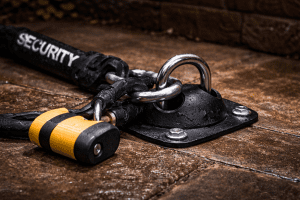
The foundation. Drilled into the concrete or tarmac, with the chain run through the frame or rear wheel and back through the anchor. This is what stops lift-and-load. Without it, the other layers are still useful but they’re defending against secondary threats. See our guide to the best motorcycle ground anchors for UK-specific options across different driveway surfaces, including tarmac.
Our current recommendation is the Torc Mega Series III
Layer 2 > Chain and lock.

Run through the anchor, through the frame or rear wheel, and locked with a closed shackle padlock. Sold Secure Gold or Diamond only, anything below that has been tested and found to fail faster than the rating implies security. Keep the chain off the ground; a chain lying on tarmac can be hammered against it to break the links. See our guide to the best motorcycle chains and locks.
Our best budget offering is the Oxford HD Chain and Padlock
Layer 3 > Alarmed disc lock.
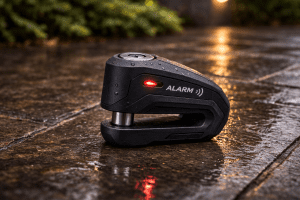
Fitted to the front disc every time the bike is parked. Stops ride-away and adds a 100–120dB siren to any attempt to move the bike. On a driveway, where a thief is visible from the road and potentially from neighbouring houses, noise matters. A 120dB siren going off at 2am changes the risk calculation. See our guide to the best alarmed disc locks.
Our best overall alarmed disc lock is the Abus Granit Detecto XPlus
Layer 4 > Cover.
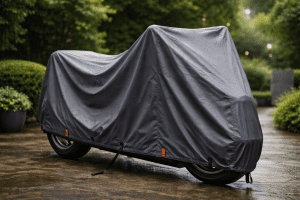
A plain, non-branded cover does two things: it hides the make and model of the bike, removing it from casual scouting; and it adds a step to any theft attempt. A thief assessing a street doesn’t know what’s under the cover. They do know what the uncovered bike next to it is. See our guide to the best motorcycle covers for outdoor storage.
Our current best all rounder is the Oxford Stormex
* Affiliate links. If you buy via these links, we earn a small commission at no extra cost to you.
Driveway-specific considerations
Block paving and tarmac. Not all ground anchors work in all surfaces. Most assume concrete. If your driveway is block paving or tarmac, check the anchor’s surface compatibility before buying — the Y Anchor is specifically designed for tarmac and is worth looking at first.
Renting. You need landlord permission before drilling into any surface. Worth asking, most landlords prefer a small hole in the driveway to a theft incident involving their property and your insurance claim. If permission isn’t possible, a heavy-duty chain run through a fixed structural point (the base of a post, a railing) is the best available alternative to a proper anchor.
Visibility. Position the bike where it can be seen from inside the house if possible, from a front-facing window, near a motion light, in camera coverage if you have it. Not because visibility alone stops theft, but because a thief who knows they’re visible works faster and is more likely to abandon the attempt.
Changing the position occasionally is worth doing. A bike that is always in the same spot can be studied in advance. Moving it a metre or two, or occasionally parking it differently relative to the house, removes that certainty.
Insurance
Most UK motorcycle insurers will reduce your premium for a declared Sold Secure-rated security setup. The specifics vary by insurer, but the combination most likely to make a difference is a Sold Secure Gold or Diamond ground anchor, a Sold Secure Gold or Diamond chain, and a Sold Secure Gold alarmed disc lock, all declared on the policy with make, model, and rating.
Keep receipts. If you make a theft claim, insurers may ask for evidence that the declared security was in place. A photo of the setup from time to time is also useful.
Be honest about storage. Declaring a garage when the bike lives on the driveway is a common mistake that can void a claim at the worst possible moment. Driveway storage is a legitimate declared option with most insurers, the premium may be slightly higher than garage storage, but it’s correct.
For a full guide to how outside storage affects your insurance, including which security ratings insurers recognise and how to declare correctly, see our motorcycle insurance guide.
Summary
A driveway setup doesn’t need to be complicated. Ground anchor, chain, disc lock, cover, applied consistently, is enough to make the bike a significantly harder target than most of what’s parked on UK driveways. The investment is a few hundred pounds and a weekend’s installation. The alternative is relying on luck, which works until it doesn’t.
If you rent (the most common complication)
Drilling into a driveway or wall to fit a ground anchor requires your landlord’s permission if you are renting. Some landlords will agree, particularly if the installation is neat and the anchor adds value to the property. Others will not. It is worth asking directly and explaining what is involved, because a refusal based on not understanding the job is different from a principled refusal.
If permission is not forthcoming, the practical alternatives are:
- Wall anchor with landlord permission: a single bolt anchor on the house wall is less invasive than a ground anchor and easier to make good if you leave. Often easier to get permission for than a driveway installation.
- Park behind your car: positioning the bike directly behind a car on the driveway defeats the lift-and-load method entirely. A van cannot pull up and load a bike that has a car between it and the road. It is not a complete solution on its own, but it eliminates the fastest and most common attack method.
- Portable ground anchors: heavy concrete-filled ground anchors exist that sit on the surface without fixing. They are less secure than a properly installed anchor under a determined attack, but they are considerably better than nothing and are an option where drilling is not permitted. Some insurers will accept them as a declared security measure; check before relying on one for insurance purposes.
- Spiral anchors in soil: if your driveway has a grass or soil border, a spiral ground anchor hammered into the ground can provide a usable anchor point without any permanent modification. The security level is lower than a concreted anchor but the installation leaves no lasting trace, which matters when renting.
If you are coming up to renewing a lease, it is worth flagging motorcycle storage explicitly. Some tenancy agreements have clauses about alterations, and negotiating an anchor installation as part of renewing a lease is often easier than asking mid-tenancy.
Driveway-Specific Positioning
Where you park on the driveway matters beyond just having space. A few points that are specific to driveway situations:
Park with the front of the bike facing the road where possible. This positions the front wheel closest to any approaching threat, and the front brake disc is the more effective target for an alarmed disc lock than the rear. It also means a thief attempting to wheel the bike out has to turn it first, which adds time and awkwardness.
Use your car as a barrier. If you have a car and a bike sharing the driveway, parking the car at the road end with the bike behind it removes the clear access a van needs for lift-and-load. A thief needs the van alongside the bike to use the scaffolding pole method. If a car is in the way, the whole operation becomes significantly harder and slower.
Vary the position slightly. Not dramatically, but a bike that is in an identical position every single day is easier to observe and plan around than one that moves a few feet. If your driveway gives you options, use them occasionally.
Consider a gate if your driveway allows it. Even a basic gate across the driveway entrance creates a physical barrier that slows access and, crucially, means any attempt to bring a van alongside the bike requires opening or breaking the gate first. That is noise and time. A lockable gate is not impenetrable but it changes the risk calculation at the entrance before the bike is even reached.
Related Guides
For the full security picture beyond the driveway itself, the rest of the site goes into the product detail:
- The best motorcycle ground anchors — bolt-down and bury-in options at every budget, with Sold Secure ratings verified
- The best motorcycle chains and locks — from everyday Gold-rated options to serious Diamond-rated chains for high-value bikes
- The best motorcycle D-locks — including angle-grinder resistant options for the second lock on the wheel
- Best alarmed disc locks for UK riders — the noise layer, covering options from budget to Thatcham approved
- The best motorcycle covers for outdoor storage — waterproof, breathable, and plain enough to keep the bike anonymous
- Motorcycle insurance for bikes stored outside — what to declare, how to declare it, and which insurers are most straightforward about outside storage