Security Guides / Travelling
The short version: Taking your security kit on the road raises questions that staying at home never does. This guide covers every practical method for carrying chains, disc locks, D-locks and more when you are away from home, including the carry risks that most touring security guides overlook entirely.
Most riders think carefully about security at home. A ground anchor bolted into the driveway, a rated chain, a disc lock on the wheel. But the moment you plan a touring trip, a weekend away, or even an overnight stop somewhere unfamiliar, a different set of problems appears.
What do you actually bring with you? Where does it go on the bike? How do you balance the weight and bulk of serious security against the practicalities of long-distance riding? And, less often discussed, where you put it has implications for your safety if something goes wrong on the road.
There is no single right answer. The best approach depends on your bike, your luggage setup, your destination, and how long you are away. What follows is a breakdown of the main methods riders use, with the honest trade-offs for each.
Understanding the weight problem first
Before looking at how to transport security devices, it is worth being clear about why this is a problem in the first place.
A Sold Secure Motorcycle Diamond rated chain of the kind you would use at home weighs anywhere from 10kg to 16kg for a 1.5m length. That is not going on a touring bike alongside camping kit, clothing, and tools without some serious thinking. Even a Sold Secure Gold chain typically comes in at 6kg to 8kg. These are not light objects.
The best home security products are deliberately heavy because weight and steel density are part of what makes them resistant to attack. A chain that is light enough to carry comfortably on a motorbike is, almost by definition, a lighter security proposition than the one sitting on your driveway.
This does not mean travelling with no security. It means accepting that your travel security will be a step down from your home security, and planning accordingly.
The safety case for thinking carefully about where you carry it
Weight is not the only consideration when deciding what to bring. Where a security device sits on the bike has implications for rider safety that are very rarely discussed in touring guides, but are worth understanding before you decide on a method.
Watch where you put it.
A chain wrapped around the subframe or threaded through passenger grab handles creates a rigid, unyielding mass at leg and torso height. In a low-speed tip or a slide, that chain does not compress or deform the way soft luggage does. A heavy padlock sticking out from a chain loop is essentially a blunt metal object in exactly the place your body or a passenger’s body is likely to make contact.
Similarly, a D-lock or U-lock mounted externally can become a contact point in a fall. This is a known concern in the cycling world, where D-lock positioning has been discussed in relation to crash injury for years, but it rarely comes up in motorcycling conversations.
Inside a pannier or top box is generally the safest place for security devices. Even there, however, an unsecured chain can shift weight abruptly under heavy braking or change the balance of a fully loaded touring bike through fast corners. Wrapping the chain in clothing or a dry bag before putting it in a soft bag reduces the risk of it moving around as a single shifting mass.
The practical upshot is that the carry method matters as much as the product choice. A lighter device carried safely is a better outcome than a heavier device carried badly.
What most touring riders actually use: the D-lock
If you spend time in touring forums and bike security discussions, a clear pattern emerges. Riders who set off with heavy chains consistently report that carrying them on a multi-day trip becomes impractical, and the kit that actually gets used trip after trip is a D-lock paired with a disc lock.
A quality D-lock at 1.0kg to 1.5kg is meaningfully harder to defeat than a disc lock alone, can be used to anchor the bike to a fixed point such as a railing, post, or another bike, and packs into a hard pannier without dominating the available space. It is the most practical balance of security, weight, and packability that most riders settle on after a trip or two with a heavy chain.
The LiteLok range has become a popular choice among touring riders in particular, largely because the rubberised coating solves one of the most persistent complaints about carrying a D-lock on the bike: rattle. A metal lock mounted in any external position will vibrate against whatever it is touching over the course of a long ride, which is both irritating and causes paint or bodywork damage over time. A rubberised coating eliminates that problem and also means the lock can be positioned tightly in a gap without needing additional padding.
A carry position that actually works.
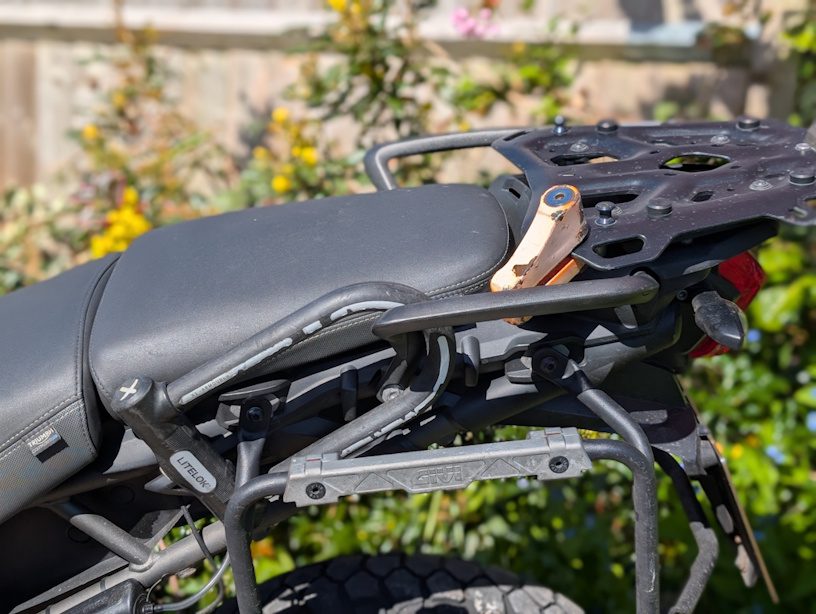
One setup that works well in practice is mounting the LiteLok between the passenger grab rail and the pannier frame. The lock sits flush, does not protrude into any crash-risk zone, does not rattle, and is immediately accessible when you arrive without needing to open any luggage. For the disc lock, if you are travelling without a top box, the mounting rack has holes or gaps that are a natural location to slip it through — rattle-free and instantly accessible. It is the kind of solution that only emerges from actually riding with the problem rather than thinking about it at home.
Pros
- Significantly lighter than any rated chain: typically 1.0kg to 1.5kg
- Can anchor the bike to a fixed object, unlike a disc lock
- Packs into a hard pannier or mounts externally without dominating space
- Rubberised options such as the LiteLok eliminate rattle and bodywork contact damage
- A mount point between the grab rail and pannier frame keeps the lock flush and away from crash-risk positions
- Fast to deploy on arrival
Cons
- Lower resistance to sustained angle grinder attack than a serious chain
- The shackle gap limits what fixed points you can use it with: thick lamp posts and wide barriers will not work
- Sold Secure Motorcycle Diamond D-locks exist but are a small specialist category, specifically angle-grinder resistant products such as the LiteLok X1 and X3 and the Hiplok DX1000.
- Externally mounted, even flush, it is visible and identifies you as carrying security kit
The D-lock is the most practical security device most touring riders end up with. It is not a compromise made through ignorance — it is the product of experience. Light enough to carry, effective enough to deter opportunistic theft, and mountable in a position that does not create a crash hazard.
Pairing the D-lock with a disc lock
The combination most touring riders end up with is a D-lock for overnight security at a fixed point, and an alarmed disc lock for every other stop. The disc lock weighs around 500g to 800g, fits in a jacket pocket, and takes seconds to deploy at a petrol station, a café stop, or anywhere you are leaving the bike briefly.
Pros
- Negligible weight and bulk
- Fast to fit and remove
- Alarmed versions add an audible deterrent
- Does not require a fixed point to be effective
- Easy to slot into jacket pocket, hard luggage, or the top box rack frame holes when travelling without a top box
Cons
- Does not anchor the bike to anything: it can still be lifted and moved
- Substantially lower security than a D-lock or chain against a determined thief
- Easy to forget it is fitted to the wheel; always use the reminder cable
Method: carrying a chain in a tail bag or top box
For riders who want more security at their overnight stop than a D-lock provides, or who are travelling to areas where theft risk is genuinely higher, a mid-weight chain remains an option. The chains that work best for travelling are shorter lengths in the 1.0m range with a Sold Secure Gold rating. At 1.0m, a 16mm Pragmasis Protector weighs around 4.5kg. The Squire Massiv at 1.2m is in similar territory.
Pros
- Higher resistance to sustained attack than a D-lock
- Can be used with a portable anchor at the destination
- Inside a hard pannier or top box, the chain is protected from road spray and does not affect bodywork
Cons
- 4.5kg to 6kg is significant extra weight on an already loaded touring bike
- Takes up a substantial portion of a top box or tail bag
- A wet fabric chain sleeve against clothing is unpleasant; a dry bag liner helps
- Heavier than most riders want to carry for more than one or two nights
If you are carrying a chain in a soft bag.
Put it in a dry bag first and pack it low and central, not in a tail bag that amplifies weight behind the rear axle.
Method: wrapping the chain around the frame or subframe
Some riders wrap a shorter chain around the subframe or seat hoop to free up luggage space. It can work, but it is the carry method with the greatest safety trade-off.
The crash risk with this method is real.
A chain in this position sits at exactly the height where a rider’s leg or a pillion’s leg makes contact in a tip or a slide. The chain does not flex or compress. A heavy padlock adds a specific hard point to that risk. If you use this method, a shorter chain with the lock positioned inward and downward, rather than outward, reduces the exposure.
Pros
- Frees up luggage space
- Weight is kept roughly central on the bike
Cons
- Significant injury risk in any fall or tip: a rigid chain at leg height does not give way
- Chain is exposed to road spray and salt for the entire journey
- Can cause paint damage without a proper sleeve or protection
- Difficult on bikes with full fairings
Method: planning your route around secure overnight parking
An underused approach is researching secure bike parking at overnight stops before leaving, and choosing accommodation accordingly. Some hotels have locked, covered parking. Some campsites have dedicated motorcycle areas. If you know the bike will be in a secure location overnight, a disc lock and a tracker may be entirely sufficient, which changes the packing equation entirely.
Pros
- No security weight to carry at all beyond a disc lock
- Removes the overnight exposure that matters most
- A GPS tracker combined with secure parking is a genuinely credible travel security setup
Cons
- Requires advance research and booking flexibility
- Costs more: accommodation with secure parking tends to be dearer
- Does not help at daytime stops where you have no control over the environment
Trackers: the one travel security device with no carry cost
Worth fitting before you leave.
A GPS tracker fitted to the bike before you leave adds nothing to your luggage weight and nothing to your carry decisions. It does not prevent theft, but it significantly improves the chance of recovery. For touring, it is arguably the highest-value security upgrade precisely because the carry cost is zero. It runs quietly in the background regardless of whatever else you decide to bring.
Note: It’s run cost may be much more than zero
Putting it together: a practical touring setup
The setup that most experienced touring riders arrive at, often after learning the hard way on a first trip with too much kit, looks something like this:
A D-lock mounted in a fixed external position on the bike where it sits flush and rattle-free, paired with an alarmed disc lock in a jacket pocket or the top box rack. A GPS tracker running permanently. Overnight accommodation chosen with parking in mind where the route allows.
No part of this is as secure as a Sold Secure Diamond chain bolted to a concrete ground anchor on your own driveway. But it is a credible, practical setup that you will actually use on every stop, every night, without it taking over your luggage or compromising the ride.
The right setup is the one that gets used. A 15kg chain that stays at home because carrying it is too much hassle does nothing for your bike parked outside a Travelodge in Carlisle.
Further reading on Motorbike Outside:
• The 5 best motorcycle chains and locks for outside storage (UK, 2026)
• The 5 best alarmed motorcycle disc locks (UK, 2026)